Top Designers’ Favorite White Marbles for Timeless Interiors

White marble has never relied on trend to remain relevant. It has endured because it understands space in a way few materials do. It reflects light without harshness, expands a room without effort, and carries a quiet permanence that outlasts changing design languages.
What makes it truly compelling is not its color, but its ability to adapt without losing identity. No two marbles behave the same. Each carries its own rhythm of veining, its own tonal temperature, its own relationship with light. This is where design begins, not in choosing marble as a category, but in understanding which marble belongs to a space.
The decision is rarely aesthetic alone. It is spatial, emotional, and architectural. When chosen with clarity, white marble does not sit within a design, it becomes part of its foundation.


The Language of White Marble: What Designers Really See
White marble is never simply white. It is read through tone, movement, and surface behavior, all of which shape how a space is experienced.
Tone defines atmosphere before anything else. Cooler whites introduce clarity and precision, often aligning with modern compositions. Warmer whites soften the environment, allowing materials like wood, brass, and textiles to feel more grounded and cohesive.
Veining is where marble begins to speak. Linear veins bring order and direction, guiding the eye with intention. Cloud-like formations soften transitions and create a more relaxed visual flow. Strong, expressive veining introduces structure, almost like an architectural gesture within the surface itself.
Grain and variation determine how calm or dynamic a space feels. Uniform slabs create continuity, allowing the room to settle visually. High variation introduces movement and contrast, shifting marble from background to focal element.
Finish transforms how marble interacts with light and touch. A polished surface reflects and amplifies, adding depth and clarity. A honed finish absorbs light, creating a softer and more understated presence. Texture introduces tactility, grounding the material in a more natural, lived-in expression.
Most Coveted White Marble Varieties That Define Global Luxury


Carrara Marble
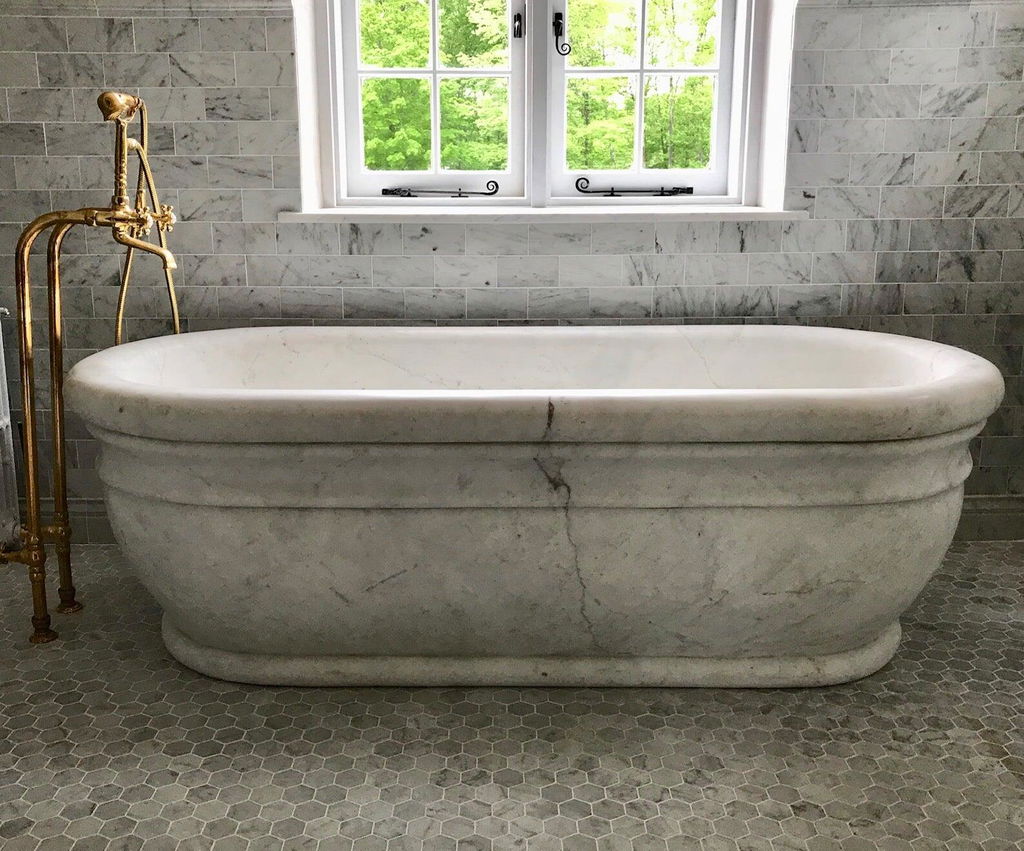
Carrara marble is not chosen to stand out. It is chosen to bring a sense of quiet resolution to a space. Its soft grey veining creates a gentle visual rhythm that allows interiors to feel balanced, composed, and complete without appearing overdesigned.
Carrara marble is not chosen to stand out. It is chosen to bring a sense of quiet resolution to a space. Its soft grey veining creates a gentle visual rhythm that allows interiors to feel balanced, composed, and complete without appearing overdesigned.


Its veining is light, diffused, and consistent, which allows it to function as a continuous surface rather than a focal interruption. This is precisely why designers return to Carrara repeatedly. It offers reliability without monotony and elegance without effort.


In kitchens, Carrara works best as countertops and backsplashes where continuity is key. It softens cabinetry lines and creates a seamless working surface. In bathrooms, it enhances openness, making even compact spaces feel more expansive and serene. Flooring applications benefit from its ability to unify large areas without visual nois


A honed finish is often preferred in high-use areas like kitchens as it reduces the visibility of etching, while polished finishes can be used in bathrooms to enhance light reflection.
Designers favor Carrara because it never dominates a design. It supports it. Its timeless appeal lies in its restraint, making it immune to trend cycles. It does not follow design movements because it adapts to all of them.
Designing with Carrara allows greater freedom in layering textures, materials, and colors, because the marble itself does not compete for attention.
Designer Insight
Best suited for kitchens and bathrooms where continuity and calm are essential. Carrara is ideal when the design needs a foundation that enhances everything else without taking control.


Calacatta Viola Marble
Calacatta Viola is chosen when a space needs identity. Its deep burgundy veining introduces richness and depth that immediately transforms the atmosphere from neutral to expressive.
Its veining behaves like bold, sweeping strokes that guide the eye across the surface, creating a natural focal point. This is why designers treat it less like a material and more like a composition.


In kitchens, it performs best as a statement island where the slab can remain uninterrupted, allowing its full character to emerge. In bathrooms, it creates a strong visual narrative, especially in vanities or feature walls where contrast enhances the overall experience.
A polished finish amplifies its depth and enhances the richness of its tones, making it the preferred choice for showcasing its full visual impact.


Designers are drawn to Calacatta Viola because it offers individuality. No two slabs feel identical, and this uniqueness gives interiors a curated, almost bespoke quality. It remains timeless not because it is subtle, but because it is distinctive in a way that cannot be replicated by artificial materials.
Designing around Calacatta Viola creates a clear hierarchy within the space. It simplifies decision-making because the marble itself becomes the reference point for all other materials.


Designer Insight
Best used in kitchens as a statement island or in bathrooms as a focal surface. Let it lead the design and keep surrounding elements restrained to preserve its impact.


Statuario Marble
Statuario marble exists in balance. It carries the softness of Carrara and the strength of Calacatta, making it one of the most refined choices in white marble.
Its veining is bold yet controlled, allowing it to introduce structure without overwhelming the space. This balance is what makes it highly favored by designers working on luxury interiors.


In kitchens, Statuario works beautifully for countertops and islands where a sense of refinement is required without excessive contrast. In bathrooms, it elevates the space into something more architectural, especially when used in larger slabs or bookmatched walls.
A polished finish enhances its contrast and clarity, making it ideal for feature applications, while honed finishes can be used in functional areas for a softer effect.


Designers prefer Statuario because it offers both presence and versatility. It adapts across styles, from classic to modern, without losing its identity. Its timelessness comes from this balance, making it relevant across decades of evolving design trends.
Designing with Statuario creates interiors that feel intentional and composed. It allows for both statement and subtlety within the same material.


Designer Insight
Ideal for kitchens and bathrooms where elegance and structure need to coexist. Use it when the space requires definition without excess.


Panda White Marble
Panda White is chosen for impact. Its sharp black veining creates a graphic contrast that immediately defines the space.
Its veining is bold and directional, often appearing as strong visual strokes that divide the surface into high-contrast compositions. This makes it inherently focal.


In bathrooms, it works exceptionally well as a statement wall or vanity backdrop where its contrast can be appreciated without interruption. In kitchens, it is best used selectively, such as on an island or backsplash, rather than across all surfaces.
A polished finish enhances its contrast and sharpens the clarity of its veining, making it the preferred choice.


Designers love Panda White because it introduces drama without requiring additional elements. It creates visual interest on its own. Its timeless appeal lies in its graphic quality, which transcends changing trends.
Designing with Panda White simplifies interiors by allowing one surface to carry the entire visual narrative.


Designer Insight
Best used in bathrooms as feature walls or in kitchens as accent surfaces. Limit its application to maintain its strength and clarity.


Volakas Marble
Volakas marble brings warmth into white marble. Its soft veining flows gently across a creamy base, creating a space that feels inviting rather than formal.
Its veining is fluid and organic, allowing it to soften interiors without losing structure. This makes it particularly suited for residential spaces.
In bathrooms, it creates a soothing and comfortable atmosphere. In kitchens, it pairs beautifully with wood and warm-toned materials, creating a balanced composition.
A honed finish enhances its warmth and makes it more tactile, while polished finishes add brightness and clarity.


Designers favor Volakas because it humanizes marble. It feels approachable while still refined. Its timelessness lies in its ability to create warmth within a traditionally cool material.
Designing with Volakas results in spaces that feel lived-in and layered, rather than overly formal.
Designer Insight
Ideal for bathrooms and kitchens where warmth is essential. Pair it with natural materials to enhance its character.


Designing with Intention: Matching Marble to Space
Every space asks something different from marble.
In kitchens, the material must balance elegance with use. Surfaces are not only seen, they are lived on. A honed finish allows the marble to age more gracefully, while controlled veining ensures the space does not feel visually heavy.
Bathrooms rely on marble to create atmosphere. Lighter tones and softer patterns open the space, allowing light to move freely. Here, marble becomes less about surface and more about experience.
Living areas shift marble into a focal role. It can either define the room through a strong statement or unify it through subtle continuity. The decision lies in whether the design calls for emphasis or calm.
In commercial and hospitality environments, durability and consistency become essential. Marble must perform without losing its presence, creating spaces that feel both refined and resilient.
Veining as Visual Architecture
Veining is not decoration. It is direction.
It guides how the eye moves across a surface and, in doing so, shapes how a space is perceived. Bookmatching transforms marble into symmetry, creating compositions that feel intentional rather than accidental.
Large slabs preserve this movement, allowing patterns to remain uninterrupted. Smaller formats break it, shifting the visual language entirely.
Through alignment and scale, marble becomes more than material. It becomes a structural element within the design.


Finishes, Edges, and Fabrication
Luxury is rarely defined by material alone. It is defined by how that material is finished.
A polished surface enhances depth and reflectivity, bringing clarity to veining. A honed finish softens the visual impact, creating a quieter presence. Texture introduces practicality while adding character.
Edges refine the final expression. Sharp lines create precision, while softer profiles introduce fluidity. Thickness adds weight, not just physically, but visually.
These decisions determine whether marble feels applied or integrated.
Caring for White Marble
Marble is not maintained to preserve perfection. It is cared for to preserve intention.
Sealing protects the surface without altering its character. Gentle cleaning maintains clarity without dulling the finish. Avoiding harsh substances ensures that the material ages without damage.
Over time, marble develops subtle variations. These are not flaws. They are part of its evolution, adding depth and authenticity to the surface.


Trends and Timelessness
White marble does not follow trends. It absorbs them.
Its neutrality allows it to move across styles without resistance. Whether within classical architecture or contemporary minimalism, it remains relevant because it does not impose itself.
Its value lies in this adaptability. It creates continuity in spaces where everything else may change.
Choosing with Clarity
Selecting white marble is not about preference alone. It is about understanding how a material will shape a space over time.
When chosen with intention, marble becomes more than a surface. It becomes part of the architecture, influencing light, movement, and atmosphere.
At Marblebee, this approach is central. Each marble or stone material is not only selected, but interpreted. The focus is not on supplying stone, but on aligning it with design intent, ensuring that every piece fits both function and vision.
Timeless interiors are not created through excess. They are created through decisions that are precise, considered, and deeply understood. White marble remains one of the most enduring of those decisions.