11 Types of Marble Surface Finishes

In architectural design, the selection of marble extends beyond color, veining, and provenance. The surface finish is an equally significant specification, influencing how the material responds to natural light, interacts with adjacent finishes, and contributes to the spatial character of an interior.
The same marble can express entirely different architectural qualities depending on its treatment. A polished Calacatta marble surface introduces reflectivity and visual depth, while a honed finish creates a quieter, more restrained material expression. More pronounced treatments, such as bush hammering or natural splitting, emphasize the physical character of stone through texture, shadow, and relief.
1. Honed Marble Finish
What Is a Honed Marble Finish?
Honed marble is characterized by a smooth, non-reflective or softly reflective surface. Depending on the level of refinement, its appearance ranges from matte to satin.
In contemporary interiors, honed marble is frequently specified where the intention is to emphasize the material's natural composition without introducing strong reflections.
The reduced sheen allows veining and tonal variations to remain visible while creating a more subdued relationship between the stone and surrounding materials.
Common Architectural Applications
Honed marble is commonly specified for residential bathrooms, vanity tops, interior flooring, fireplace surrounds, and wall cladding.
It is especially appropriate for contemporary residences, minimalist interiors, and hospitality environments where a restrained material palette is desired.
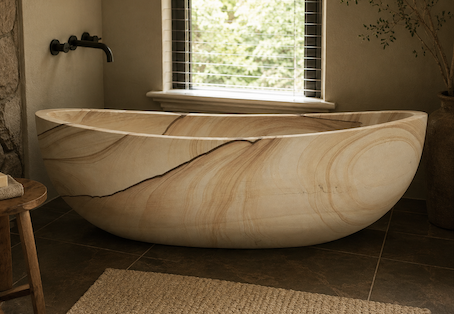
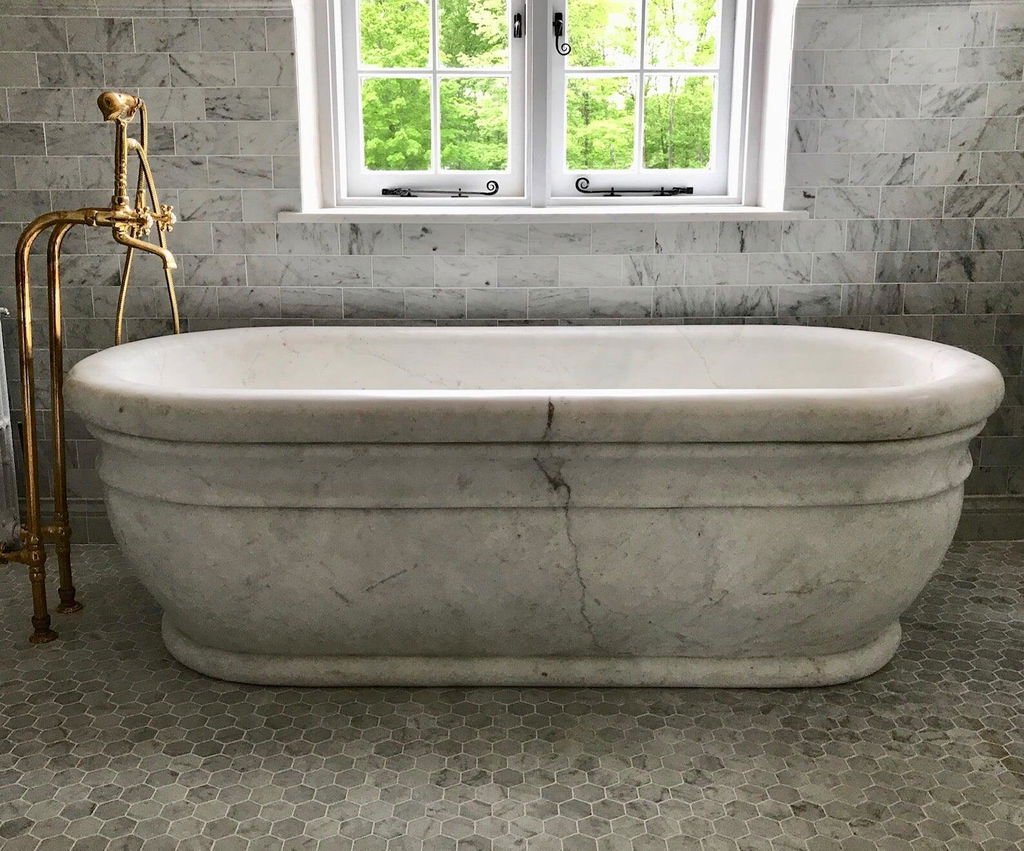
For freestanding marble bathtubs and washbasins, a honed finish can establish a soft, monolithic appearance that emphasizes form and proportion.

2. Polished Marble Finish
What Is a Polished Marble Finish?
Polished marble is distinguished by its smooth, highly reflective surface.
The finish intensifies the stone's natural coloration and creates greater visual contrast between the background and its veining.
In architectural interiors, polished marble is often used as a focal material, particularly when the stone features distinctive mineral patterns or dramatic veining.
Common Architectural Applications
Polished marble is frequently used in luxury residential interiors, hotel lobbies, reception areas, decorative columns, feature walls, and fireplace surrounds.
It is also a common specification for vanity tops, sculptural washbasins, and architectural furniture.
For statement marble fireplaces, polished finishes are particularly effective in emphasizing dramatic veining and the continuity of stone across adjoining components.

3. Antique Marble Finish
What Is an Antique Marble Finish?
Antique marble refers to a family of surface treatments designed to reproduce the visual qualities of aged or naturally weathered stone.
The surface typically exhibits reduced sheen, softened detailing, and subtle irregularities associated with prolonged use.
Unlike honed or polished marble, an antique finish is not defined by a single standardized fabrication process.
Its appearance is determined by the combination and intensity of treatments applied.
Common Architectural Applications
Antique marble is frequently used in Mediterranean residences, traditional villas, heritage-inspired renovations, and classical interiors.
Typical applications include interior flooring, courtyards, decorative wall surfaces, carved fireplace surrounds, and architectural stone detailing.
It is especially effective in projects where newly fabricated marble must sit comfortably alongside aged timber, lime plaster, reclaimed stone, or traditional masonry.

4. Sandblasted Marble Finish
What Is a Sandblasted Marble Finish?
Sandblasted marble has a fine, granular texture and a predominantly matte appearance.
The treatment produces relatively uniform surface roughness, reducing the stone's natural reflectivity.
Architecturally, sandblasting is often selected where a consistent textured surface is required across paving, steps, or exterior stone elements.
Common Architectural Applications
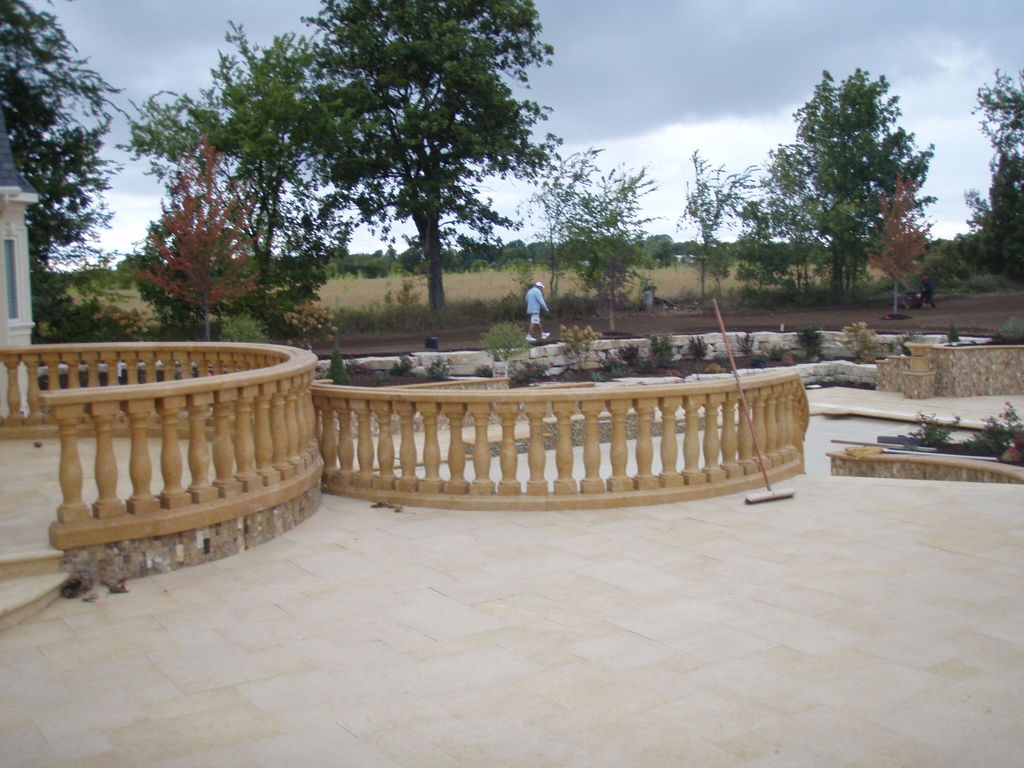
Sandblasted marble is used for exterior terraces, garden paving, stair treads, pool surrounds, and architectural cladding.
It is particularly relevant in landscape architecture and transitional spaces where stone surfaces connect interior architecture with outdoor environments.
In contemporary projects, sandblasted marble can provide a visually restrained alternative to more pronounced textured finishes.

5. Brushed Marble Finish
What Is a Brushed Marble Finish?
Brushed marble is characterized by a subtly textured surface with a soft, tactile quality.
The finish retains much of the stone's natural visual character while introducing shallow surface relief.
Compared with polished marble, brushed finishes generally create a more understated response to light.
Common Architectural Applications
Brushed marble is commonly used in spa interiors, residential bathrooms, wellness environments, decorative wall cladding, and vanity tops.
It is also appropriate for architectural furniture and sculptural stone elements where tactile quality is part of the design intention.
For custom marble bathtubs, a brushed exterior can introduce texture while allowing the interior to retain a smoother, more easily maintained finish.

6. Axe Cut Stone Finish
What Is an Axe Cut Stone Finish?
An axe cut, or axe-dressed, finish is identified by visible tool marks produced through repeated stone dressing.
These marks may be linear, directional, or slightly irregular, depending on the tool and technique.
The resulting surface expresses the process of fabrication rather than concealing it.
Common Architectural Applications
Axe-cut finishes are associated with traditional masonry, heritage restoration, rustic facades, landscape walls, and architectural detailing.
They can also be incorporated into contemporary projects where deliberately visible craftsmanship forms part of the material concept.
For decorative marble elements, the tooling pattern should be coordinated with the scale, geometry, and detailing of the architectural component.

7. Tumbled Marble Finish
What Is a Tumbled Marble Finish?
Tumbled marble is characterized by softened edges, rounded corners, and a gently distressed surface.
The finish introduces variations that resemble the gradual wear of stone through repeated contact and movement.
It is particularly associated with small-format stone tiles and traditional paving materials
Common Architectural Applications
Tumbled marble is frequently used in Mediterranean-style residences, traditional bathrooms, courtyards, pathways, and rustic kitchens.
It is also common in decorative mosaics and small-format wall tiles.
For projects involving large marble fireplaces, bathtubs, or architectural blocks, other distressing techniques may be more practical for achieving a comparable aged appearance.

8. Leathered Marble Finish
What Is a Leathered Marble Finish?
Leathered marble has a softly textured surface with subtle relief and a subdued sheen.
The term describes the tactile quality of the finish, which can resemble the gently irregular surface of leather.
Its appearance varies according to the marble variety and the fabrication method.
Common Architectural Applications
Leathered marble is used for vanity tops, bathroom surfaces, feature walls, architectural furniture, and hospitality interiors.
It is particularly appropriate where the stone is experienced at close range and its tactile quality contributes to the design.
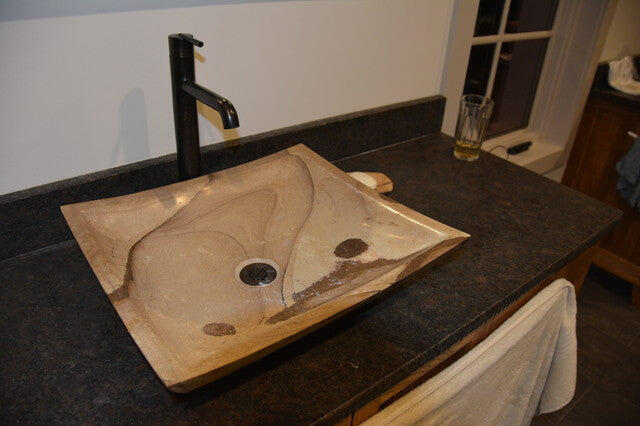
For custom washbasins or marble furniture, leathered exterior surfaces can be paired with smoother functional areas.

9. Natural-Split Marble Finish
What Is a Natural-Split Marble Finish?
Natural-split marble presents a rough, fractured surface created by physically separating the stone.
Unlike mechanically refined finishes, the exposed surface retains irregularities produced by the fracture itself.
The result is a pronounced three-dimensional texture that emphasizes the stone's geological character.
Common Architectural Applications
Natural-split marble is commonly used for feature walls, exterior cladding, landscape walls, and architectural veneers.
It can establish a strong material contrast when paired with glass, smooth concrete, polished stone, or finely detailed metalwork.
In contemporary interiors, split-face marble is often employed as a feature surface rather than a continuous finish throughout the space.

10. Bush Hammered Marble Finish
What Is a Bush Hammered Marble Finish?
Bush-hammered marble has a distinctly rough, pitted surface created through repeated impacts from a multi-point tool.
The treatment produces a granular texture that reduces reflectivity and emphasizes the physical character of the stone.
The finish can range from relatively fine to heavily textured.
Common Architectural Applications
Bush-hammered marble is used for exterior paving, stair treads, terraces, public plazas, landscape elements, and architectural wall cladding.
It is especially relevant in exterior and civic architecture, where textured stone can contribute to the visual and functional character of pedestrian spaces.
Slip-resistance requirements should be verified through appropriate testing rather than assumed from the surface texture.

11. Acid-Washed Marble Finish
What Is an Acid-Washed Marble Finish?
Acid-washed marble is a chemically treated surface in which controlled etching reduces gloss and introduces fine textural variation.
The treatment may produce a weathered or distressed appearance, depending on the marble and processing conditions.
It is a specialized finishing method rather than a routine stone-cleaning procedure.
Common Architectural Applications
Acid-washed marble is used for decorative tiles, specialty wall finishes, rustic interiors, and heritage-inspired architectural surfaces.
It may be appropriate where the design calls for a distressed material appearance.
For projects requiring consistent color and texture across multiple components, approved production samples are particularly important.

For more information about surface or if you want to order an sample, please check our marble surface sample page